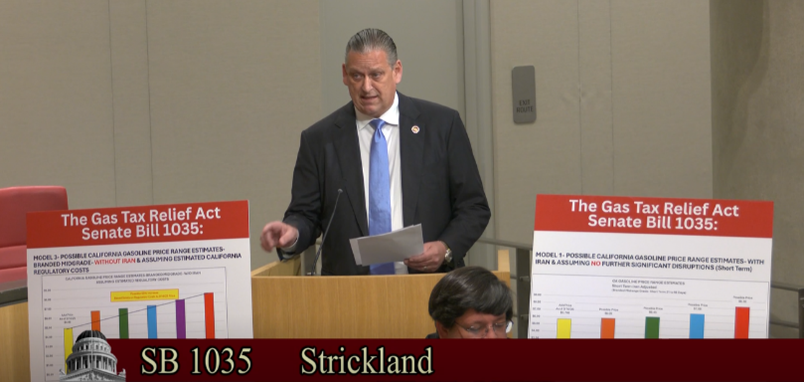
At today’s Senate Environmental Quality Committee. Click HERE to listen to his presentation.
SACRAMENTO, Calif. — Today, Senate Democrats in the Senate Environmental Quality Committee killed Senate Bill 1035, which would have provided immediate relief for California drivers at the gas pump. Authored by Senator Tony Strickland (R-Huntington Beach), SB 1035, also known as the Gas Tax Relief Act, would have offered a lifeline for drivers by lowering the price of a gallon of gas by $1.08. USC Professor Michael Mische is a public policy expert on the subject of oil and attended to testify in support of the bill. Click HERE to listen to Senator Strickland’s post-reaction and USC Professor Mische’s economic analysis of oil prices.
“To say I’m disappointed is an understatement. I’m frustrated because we have an opportunity to help working families at a time when we have an affordability crisis. Democrats in Sacramento refused to help struggling Californians,” said Senator Strickland.
Senate Bill 1035 would have provided immediate cost relief to Californians by temporarily suspending three major contributors to gasoline prices for one year, lowering the price by approximately $1.08 per gallon, and saving a typical household with two drivers between $900 and $1,100 per year.
The State gas tax
The Low Carbon Fuel Standard (LCFS)
The LCFS cap-and-invest compliance mechanism
“California anticipated tightening fuel supply with planned refinery closures by Valero and Phillips 66. While these closures are expected to reduce in-state refining capacity over time, they are not immediate. With gas prices continuing to increase, my bill is the only immediate, short-term solution. The intent is to give California drivers breathing room. Meanwhile, the Legislature must work on mid- and long-term solutions, which is why I’ve called on the governor to convene an emergency session,” added Senator Strickland.
Today, California drivers are paying about $5.56 for gas, while the national average is $3.84. In January, California drivers paid roughly $4 per gallon for unleaded gas. By mid-February, prices increased by approximately 35 to 40 cents, largely due to short-term refinery disruptions and tight supply conditions.
“Today’s vote against lowering gasoline prices for Californians was predictable and unfortunate. Irrespective of the Iranian situation, California gasoline will continue to increase simply due to the taxes and environmental programs that support initiatives such as the high-speed rail project. Regrettably, because of today’s actions, Californians will still be paying the highest gasoline prices in the nation,” said Professor Mische.
In addition, SB 1035 includes transparency requirements requiring receipts to show the amount of tax that would have been charged, allowing Californians to clearly see the savings. The bill also includes a protection clause to ensure transportation projects remain funded by temporarily providing General Fund dollars to offset infrastructure funding losses.