This morning, the California High-Speed Rail Authority Board of Directors will vote on approving the 2026 Business Plan during a meeting scheduled to begin at 9:30 a.m. The same plan was presented to Senator Tony Strickland (R-Huntington Beach), Vice Chair of the Senate Transportation Committee, during an informational hearing in April, where the project’s inspector general and the nonpartisan Legislative Analyst’s Office used words like “risky,” “unrealistic,” and “lacks transparency” to describe the plan.
“It’s time to rip the Band-Aid off on the high-speed fail,” said Senate Transportation Committee Vice Chair and Senator Strickland. “It’s an open secret in Sacramento, many know, but don’t dare to say it out loud, that the high-speed fail will never be built as proposed. Instead, my colleagues should support redirecting those funds to shovel-ready infrastructure projects across California that would deliver real results for families and businesses.”
Vice Chair Strickland has urged his Democratic colleagues to pull the plug on the project since returning to the Legislature last year. Most recently, he offered them the opportunity through amendments to defund what he has described as the “high-speed fail.” He urges others to join him in calling for defunding the high-speed rail, with an opportunity today to express their thoughts. Click HERE to learn how to join in today’s CHSRA board meeting.
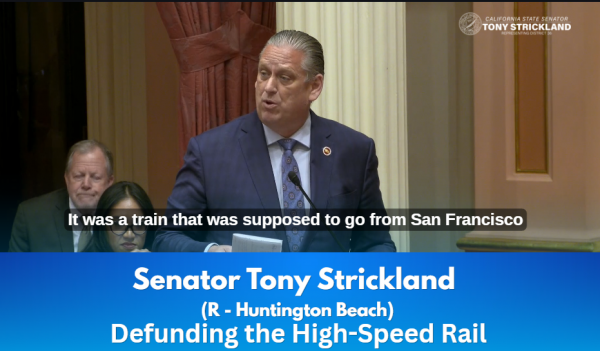
Click HERE to watch his floor remarks.
In May, he authored an Op-ed published in The Sacramento Bee and four other California newspapers owned by McClatchy Newspapers. Click HERE to read his Op-ed: California Republican leader: It’s time to pull the plug on high-speed rail.
Here is an excerpt pulled from Vice Chair Strickland’s Op-ed:
… “At a time when high-speed rail is already facing intense scrutiny over transparency and accountability, what is the response from Sacramento Democrats? They introduced a measure containing a confidentiality clause that will allow the inspector general to keep certain reports confidential if they reveal vulnerabilities that could be exploited.” …